Author(s)
John Motsamai Modise
Tshwane University of Technology, South Africa.
ISBN 978-93-88417-39-6 (Print)
ISBN 978-93-88417-27-3 (eBook)
DOI: https://doi.org/10.9734/bpi/mono/978-93-88417-39-6
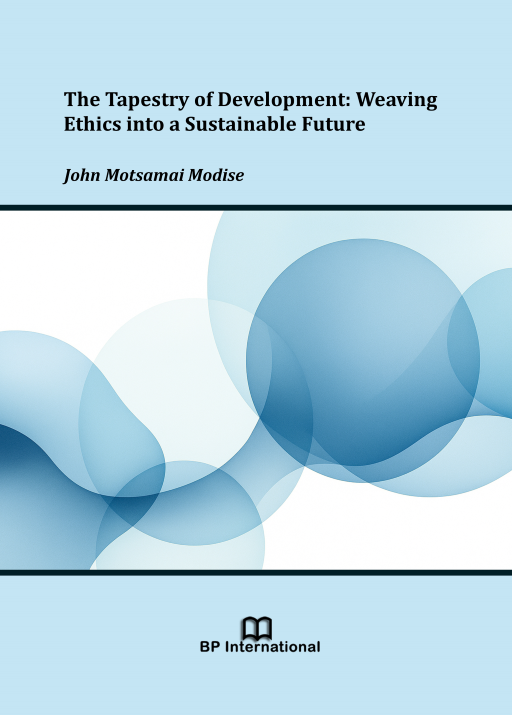
The pursuit of sustainable development is not merely a technical or economic exercise it is, at its heart, an ethical undertaking. The choices societies make about money, governance, leadership, and human dignity shape the quality of life for present and future generations. Yet, across the globe, development efforts are often challenged by corruption, exclusion, injustice, and short-term interests that undermine long-term progress. This book, The Tapestry of Development: Weaving Ethics into a Sustainable Future, seeks to address these challenges by placing ethics at the very center of development discourse.
The book is structured into four parts, each weaving together different threads of ethical inquiry to form a comprehensive vision of development rooted in integrity, justice, and responsibility.
Part I: Foundations of Ethics in Development explores the essential building blocks of ethical development practice. Financial ethics highlights the dangers of corruption and the importance of transparency in economic systems. Ethics, gender, and development examine the moral imperative of equity and inclusion, while ethical and sustainable leadership underscores the need for integrity and accountability in driving progress.
Part II: Ethics in Governance and Politics turns to the public sphere, where decisions impact entire populations. This section considers the ethical obligations of political leaders, the role of governance in eradicating poverty, and the pursuit of peace and justice as fundamental pillars of human development. It reveals how corruption and poor governance erode trust and stall development, while ethical politics and institutions can advance fairness and prosperity.
Part III: Ethics in Global Sustainability situates development within the broader global framework. Leadership for sustainable development is aligned with the Sustainable Development Goals (SDGs), emphasizing responsible innovation. The section also explores the contributions of religions to global ethical values, the role of constitutionalism in safeguarding rights, and the necessity of ethical practices in multi-party democracies. Here, the interconnectedness of ethical governance, cultural traditions, and global cooperation is emphasized as indispensable to sustainable futures.
This book is intended for scholars, policymakers, development practitioners, and all those who believe that ethical responsibility is not optional but foundational to progress. By bringing together insights from economics, politics, religion, governance, and leadership, it demonstrates that ethics is not a peripheral concern but the central thread that holds the entire fabric of development together.
Ultimately, The Tapestry of Development invites readers to envision a world where choices are guided not by narrow interests, but by a shared commitment to dignity, justice, and sustainability.
Media Promotion:
Contents
Financial Ethics: A Comprehensive Framework for Leadership Practices
John Motsamai Modise
DOI:
10.9734/bpi/mono/978-93-88417-39-6/CH1
Page: 1-40
Practical Applications of Ethical and Sustainable Leadership in Internal Management
John Motsamai Modise
DOI:
10.9734/bpi/mono/978-93-88417-39-6/CH2
Page: 41-64
Ethics, Politics, and Human Development: The Translation of Normative Frameworks into Policy and Outcomes
John Motsamai Modise
DOI:
10.9734/bpi/mono/978-93-88417-39-6/CH3
Page: 65-101
Ethics, Governance and Sustainable Pathways to Poverty Eradication
John Motsamai Modise
DOI:
10.9734/bpi/mono/978-93-88417-39-6/CH4
Page: 102-122
Interconnections of Ethics, Peace, Justice, and Human Development: Challenges and Pathways
John Motsamai Modise
DOI:
10.9734/bpi/mono/978-93-88417-39-6/CH5
Page: 123-145
Ethical Leadership and Sustainable Development: Pathways to Organizational and Societal Transformation
John Motsamai Modise
DOI:
10.9734/bpi/mono/978-93-88417-39-6/CH6
Page: 146-175
Ethics and Religions in Advancing the Sustainable Development Goals: Interfaith Pathways to Sustainability
John Motsamai Modise
DOI:
10.9734/bpi/mono/978-93-88417-39-6/CH7
Page: 176-197
Ethics, Constitution, and Sustainable Development: Foundations for Building a Rational Society
John Motsamai Modise
DOI:
10.9734/bpi/mono/978-93-88417-39-6/CH8
Page: 198-219