The Performance of a Micro-Dam Rainwater Harvesting System in an Inland-Valley Swamp in Sierra Leone
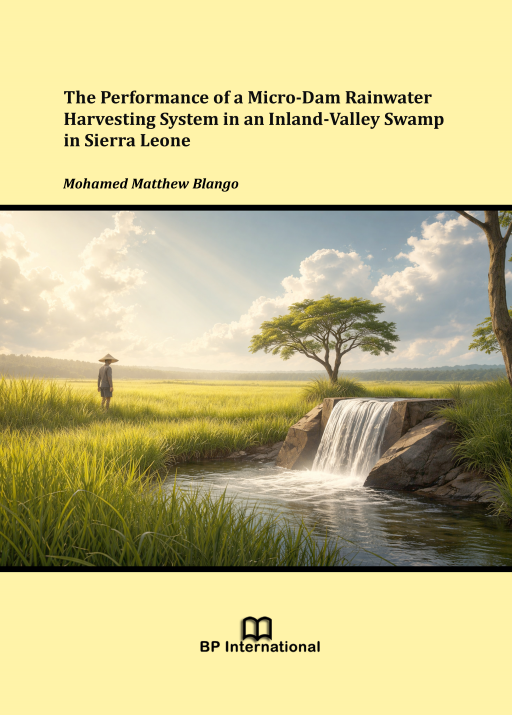
Author(s)
Mohamed Matthew Blango
Department of Agricultural Engineering, School of Technology, Njala University, Sierra Leone.
ISBN 978-93-47485-35-0 (Print)
ISBN 978-93-47485-87-9 (eBook)
DOI: https://doi.org/10.9734/bpi/mono/978-93-47485-35-0
Climate change presents an intense and growing challenge to global food security, with its impacts severely felt in the agricultural systems of nations like Sierra Leone. Increasingly erratic rainfall patterns, prolonged dry spells, and seasonal floods threaten the livelihoods of the nation's smallholder farmers, underscoring an urgent need for effective adaptation and mitigation strategies.
Sierra Leone, however, possesses significant natural advantages for agriculture. The country is situated at the northern limit of the equatorial rainforest zone, endowed with a hot, humid tropical climate and abundant land and water resources. It is one of Africa's most humid countries, with a mean annual rainfall ranging from 1,900 mm to over 4,000 mm, averaging 2,526 mm per year. This plentiful water supply underpins the great potential for sustainable agricultural intensification. A pronounced dry season from December to March and receiving only 6 to 7 per cent of the annual rainfall, which coincides with high solar radiation and lower humidity, highlighting the critical need for water conservation and irrigation. It is here that the country's extensive lowlands, particularly the network of Inland Valley Swamps (IVS), become especially promising. These fertile wetlands offer a reliable opportunity for water storage, irrigation, and year-round crop production, serving as a vital bulwark against seasonal climate variability. Recognising this potential, various IVS development initiatives have been undertaken across the country. These have often centred on water control structures to manage hydrology for cultivation. In recent years, pilot projects have introduced earth dams, structures larger and more robust than traditional head bunds as a means of harvesting and storing rainwater within these valleys. While these micro-dam systems have demonstrated promise, their implementation has yielded mixed results, with successes moderated by technical, social, and maintenance challenges.
This book presents a focused investigation into one such micro-dam rainwater harvesting system. It moves beyond a simple case study to provide a critical analysis of the system's performance. By examining its agronomic benefits, hydrological impact, and socio-economic dimensions, this work illuminates both the tangible advantages and the practical constraints encountered. Ultimately, it aims to bridge the gap between pilot-scale experimentation and widespread, sustainable adoption. The insights and evidence-based recommendations contained herein are intended to guide policymakers, developers, and farming communities in optimising these systems, thereby unlocking the full productive potential of Sierra Leone's Inland Valley Swamps and enhancing resilience for its agricultural future.
Content
The Performance of a Micro-Dam Rainwater Harvesting System in an Inland-Valley Swamp in Sierra Leone
Mohamed Matthew Blango
DOI:
10.9734/bpi/mono/978-93-47485-35-0
Page: 1-83