Author(s)
Dr. S. Balaselvakumar
Department of Geography, Government Arts College Tiruchirappalli - 620 022, Tamil Nadu, India.
S. B. Hemavarthinii
School of Agricultural Sciences, Karunya Institute of Technology and Sciences (Deemed to be University), Coimbatore 641114, Tamil Nadu, India.
ISBN 978-81-69006-97-2 (Print)
ISBN 978-81-69006-94-1 (eBook)
DOI: https://doi.org/10.9734/bpi/mono/978-81-69006-97-2
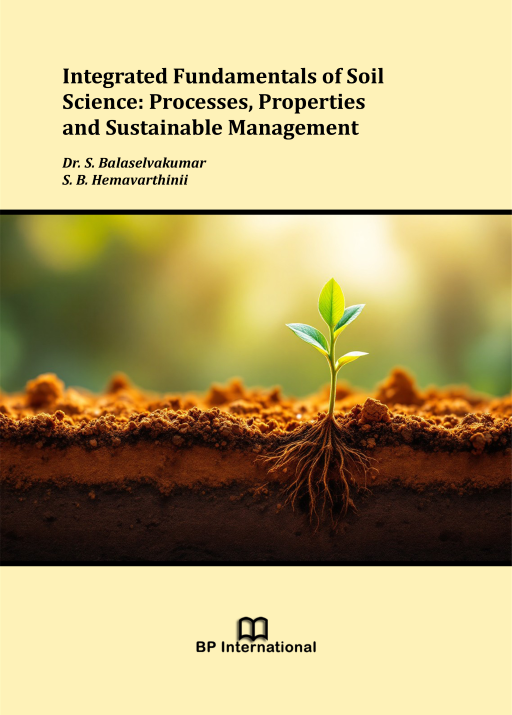
Integrated Fundamentals of Soil Science: Processes, Properties, and Sustainable Management is written in response to one of the most pressing environmental challenges of our time: the rapid degradation of the world’s soils. Today, nearly one-third of global soils are already degraded, millions of sites are contaminated, and soil is being lost far faster than it can regenerate (FAO, 2022; IPBES, 2018; UNCCD, 2022). At the same time, soils store between 1,500 and 2,400 petagrams of carbon—the largest terrestrial carbon reservoir—and remain central to feeding a global population projected to reach 10 billion by 2050. They are equally critical to climate mitigation efforts, forming a cornerstone of commitments under the Paris Agreement in more than 100 countries.
This book is designed primarily for postgraduate students and early-career researchers, but it also serves as a reference for professionals in agriculture and environmental sciences. It brings together the classical foundations of soil science with rapidly evolving tools and approaches. Readers are introduced to soils as dynamic, living systems shaped by interacting physical, chemical, and biological processes, while also engaging with contemporary advances such as digital soil mapping, remote sensing, machine learning, and precision agriculture.
Contents
Introduction to Soil Science
Dr. S. Balaselvakumar, S. B. Hemavarthinii
DOI:
10.9734/bpi/mono/978-81-69006-97-2/CH1
Page: 1-27
Soil Genesis and Formation
Dr. S. Balaselvakumar, S. B. Hemavarthinii
DOI:
10.9734/bpi/mono/978-81-69006-97-2/CH2
Page: 28-59
Soil Classification and Survey
Dr. S. Balaselvakumar, S. B. Hemavarthinii
DOI:
10.9734/bpi/mono/978-81-69006-97-2/CH3
Page: 60-88
Soil Physical Properties
Dr. S. Balaselvakumar, S. B. Hemavarthinii
DOI:
10.9734/bpi/mono/978-81-69006-97-2/CH4
Page: 89-119
Soil Chemical Properties
Dr. S. Balaselvakumar, S. B. Hemavarthinii
DOI:
10.9734/bpi/mono/978-81-69006-97-2/CH5
Page: 120-145
Soil Fertility and Nutrient Management
Dr. S. Balaselvakumar, S. B. Hemavarthinii
DOI:
10.9734/bpi/mono/978-81-69006-97-2/CH6
Page: 146-184
Soil Biology and Microbiology
Dr. S. Balaselvakumar, S. B. Hemavarthinii
DOI:
10.9734/bpi/mono/978-81-69006-97-2/CH7
Page: 185-220
Soil Physics in Agriculture
Dr. S. Balaselvakumar, S. B. Hemavarthinii
DOI:
10.9734/bpi/mono/978-81-69006-97-2/CH8
Page: 221-250
Soil Pollution and Environmental Concerns
Dr. S. Balaselvakumar, S. B. Hemavarthinii
DOI:
10.9734/bpi/mono/978-81-69006-97-2/CH9
Page: 251-277
Soil Analytical Techniques and Statistics
Dr. S. Balaselvakumar, S. B. Hemavarthinii
DOI:
10.9734/bpi/mono/978-81-69006-97-2/CH10
Page: 278-308
Land Evaluation and Land Use Planning
Dr. S. Balaselvakumar, S. B. Hemavarthinii
DOI:
10.9734/bpi/mono/978-81-69006-97-2/CH11
Page: 309-352
Practical Exercises and Field Studies
Dr. S. Balaselvakumar, S. B. Hemavarthinii
DOI:
10.9734/bpi/mono/978-81-69006-97-2/CH12
Page: 353-384