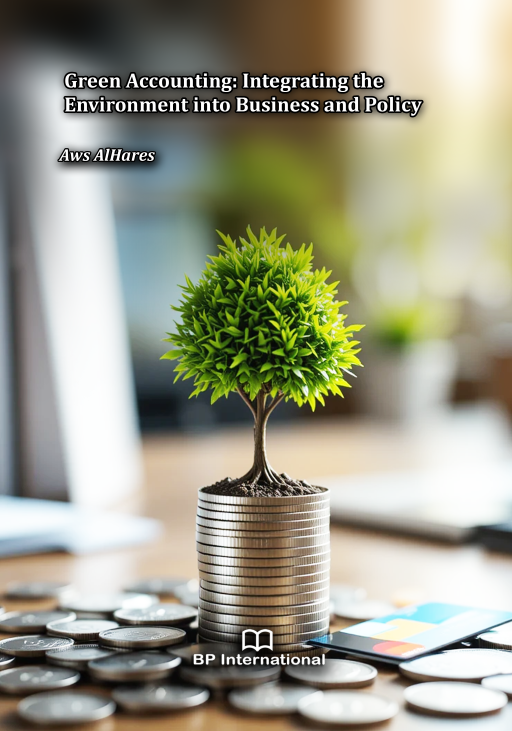
Author(s)
Aws AlHares
Department of Accounting and Finance, Prince Mohammad Bin Fahd University Al Khobar, Saudi Arabia.
ISBN 978-81-991363-9-7 (Print)
ISBN 978-81-991363-5-9 (eBook)
DOI: https://doi.org/10.9734/bpi/mono/978-81-991363-9-7
Over the past few decades, the mounting pressures of environmental degradation, climate change, and resource scarcity have prompted a critical reassessment of how we define progress, measure value, and evaluate risk. Traditional accounting systems—while vital for economic management—have largely ignored the environmental costs of development. As a result, policymakers and business leaders often make decisions without fully understanding the long-term ecological consequences. Green accounting seeks to correct this imbalance by integrating environmental factors into economic and financial systems, enabling more holistic and sustainable decision-making.
This book, Green Accounting: Integrating the Environment into Business and Policy, is written with policymakers, practitioners, and students of environmental economics, finance, and public policy in mind. It aims to bridge theory and practice by offering a comprehensive, structured introduction to the principles, evolution, and applications of green accounting.
Chapter 1 lays the foundation by introducing the core idea of green accounting and explaining why it is essential in the current global context.
Chapter 2 traces the historical evolution of the field, exploring how and why green accounting has emerged as a response to both economic inefficiencies and environmental crises.
Chapter 3 delves into key concepts and analytical frameworks, offering practical tools for measuring environmental assets, valuing natural capital, and incorporating sustainability into economic and policy models.
Chapter 4 turns to the corporate world, examining how companies are integrating green accounting into financial and non-financial reporting, driven by regulatory shifts, investor expectations, and reputational considerations.
This book is designed not only to educate, but also to inspire action. Whether you are shaping environmental policy, leading corporate sustainability initiatives, or designing public sector budgets, the insights and tools presented here aim to support a more balanced and responsible approach to value creation—one that fully accounts for the ecological systems on which our economies ultimately depend.
The transition to a greener, more sustainable economy will require a fundamental shift in how we account for environmental resources. This textbook is a step toward that transformation. We hope it will empower its readers to play an active role in redefining progress for a more sustainable future.
Content
Green Accounting: Integrating the Environment into Business and Policy
Aws AlHares
DOI:
10.9734/bpi/mono/978-81-991363-9-7
Page: 1-125