Author(s)
Dr. S. Balaselvakumar
Department of Geography, Government Arts College, Tiruchirappalli, Tamil Nadu, India.
Dr. P. Mary Santhi
Convent of Jesus and Mary, Agra, Uttra Pradesh, India.
ISBN 978-81-992493-7-0 (Print)
ISBN 978-81-992493-0-1 (eBook)
DOI: https://doi.org/10.9734/bpi/mono/978-81-992493-7-0
Climate change is no longer a distant or abstract concern—it is a lived reality, shaping landscapes, livelihoods, and lives across the globe. From melting glaciers in the Himalayas to intensified cyclones on India's coasts, the signs are undeniable. As the planet warms and weather patterns become more erratic, it is imperative that we develop not only scientific understanding but also locally grounded, geographically nuanced solutions.
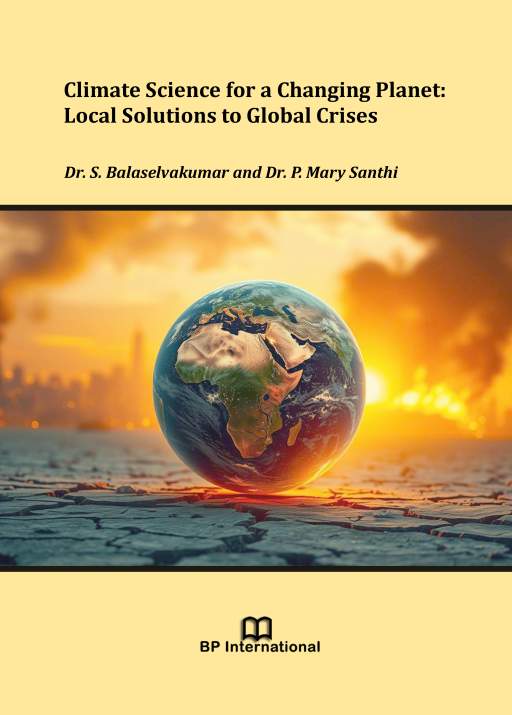
This book, Climate Science for a Changing Planet: Local Solutions to Global Crises, is a timely contribution to both academic and practical discourses on climate change. It is designed to bridge the gap between complex scientific research and the real-world needs of students, policymakers, practitioners, and communities. The content integrates climate science with geography, sustainability, and regional case studies—making it highly relevant for learners in the Indian context and beyond.
The chapters combine theoretical frameworks from environmental geography, political ecology, and sustainable development with empirical evidence drawn from national and international sources. With Geographic Information Systems (GIS), remote sensing, climate modelling, and case studies from across India, we aim to demonstrate how climate change must be understood not only as a global phenomenon but also as a spatial and socially differentiated process.
The book emphasises the urgency of climate action, while highlighting hopeful pathways for resilience—through renewable energy, climate-resilient agriculture, inclusive planning, and community-based adaptation. It also underlines the indispensable role of geography in shaping informed, just, and sustainable climate policies.
We hope that this book will serve as a valuable resource for all, especially for undergraduate and postgraduate students of Geography, Environmental Science, Forestry, Biology, Disaster Management, Climate Science and Sustainable Development Studies, as well as for teachers, researchers, civil society actors, and decision-makers who are working toward a more climate-resilient future.
We are deeply grateful to the contributors, reviewers, and institutions that supported this endeavour, and we invite our readers not only to read it but also to engage critically, locally, and responsibly with the challenges and possibilities presented herein.
Content
Climate Science for a Changing Planet: Local Solutions to Global Crises
Dr. S. Balaselvakumar, Dr. P. Mary Santhi
DOI:
10.9734/bpi/mono/978-81-992493-7-0
Page: 1-305