Author(s)
Dr. Megna Rashid Bakshi
Faculty of Forestry, Division of Silviculture and Agroforestry, Sher-e-Kashmir University of Agricultural Sciences and Technology of Kashmir (SKUAST-K), Benhama, Ganderbal, Jammu & Kashmir, 191201, India;
Dr. M. Maqbool Rather
Faculty of Forestry, Division of Forest Biology and Tree Improvement, Sher-e-Kashmir University of Agricultural Sciences and Technology of Kashmir (SKUAST-K), Benhama, Ganderbal, Jammu & Kashmir, 191201, India.
Dr. Aafaq A. Parrey
Faculty of Forestry, Division of Silviculture and Agroforestry, Sher-e-Kashmir University of Agricultural Sciences and Technology of Kashmir (SKUAST-K), Benhama, Ganderbal, Jammu & Kashmir, 191201, India.
ISBN 978-81-69986-85-4 (Print)
ISBN 978-81-69986-84-7 (eBook)
DOI: https://doi.org/10.9734/bpi/mono/978-81-69986-85-4
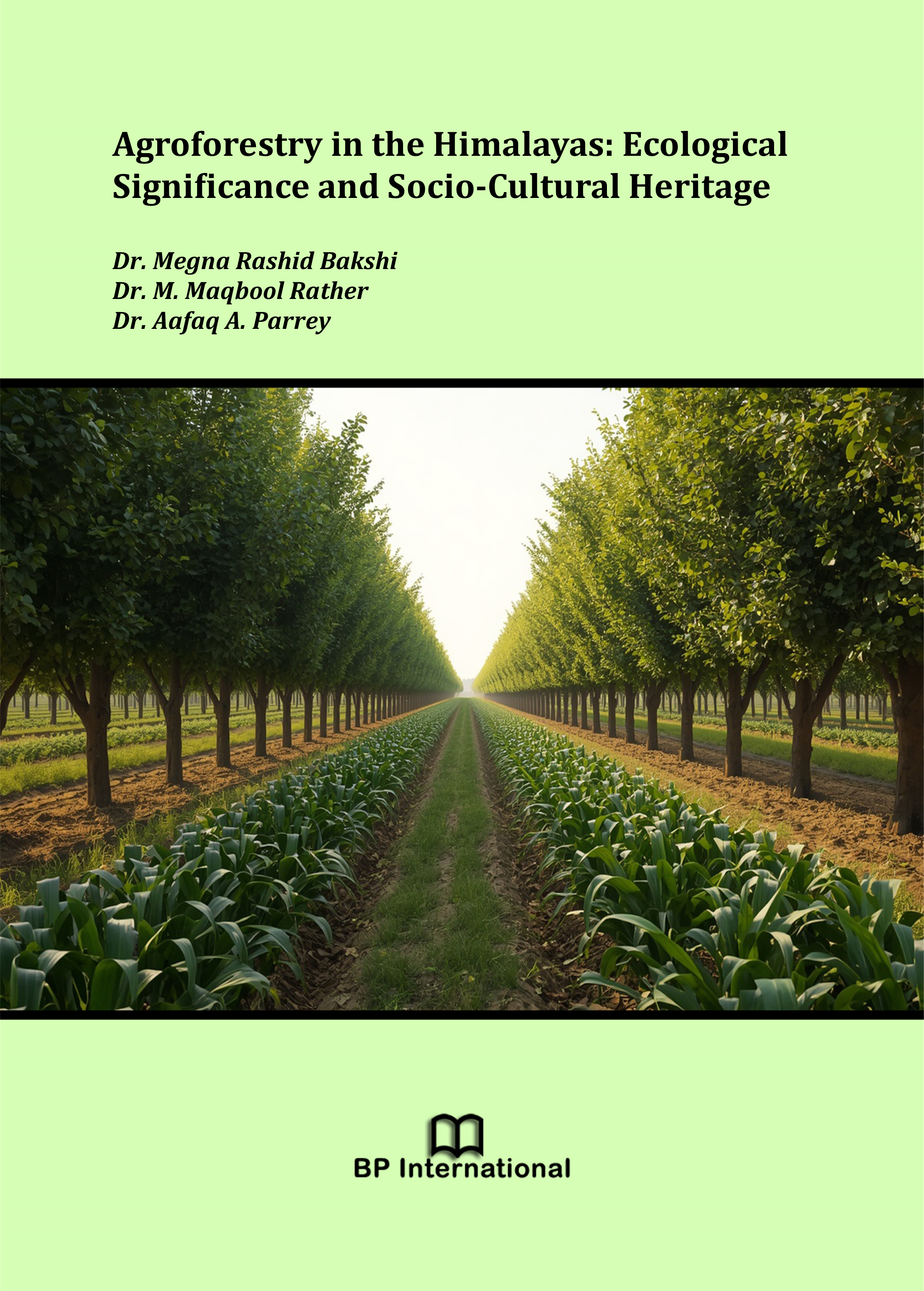
Agroforestry has long been an integral component of Himalayan landscapes, supporting ecological stability, rural livelihoods, and cultural continuity across diverse mountain communities. The Himalayan region is characterized by fragile ecosystems, steep terrain, rich biodiversity, variable climatic conditions, and a strong dependence of local populations on agriculture, forests, and livestock. Within this complex environment, agroforestry has evolved as an important land-use practice that integrates trees, crops, and animals to fulfil multiple ecological, economic, and household requirements.
This book examines the ecological significance of agroforestry systems, with particular emphasis on their contributions to biodiversity conservation, soil fertility improvement, erosion control, water regulation, nutrient cycling, carbon sequestration, and microclimate moderation. It also highlights the role of multipurpose tree species and traditional management practices in enhancing the resilience and productivity of mountain farming systems under increasing environmental and climatic pressures.
Equal attention is given to the socio-cultural dimensions of agroforestry. Indigenous knowledge, customary management practices, sacred landscapes, traditional species preferences, community institutions, and locally developed conservation strategies have shaped these systems over generations. Such practices provide essential resources including food, fodder, fuelwood, timber, medicines, and other products while also preserving cultural identity, traditional knowledge, and community relationships with the natural environment.
By bringing together ecological, socio-economic, and cultural perspectives, this volume offers a holistic understanding of agroforestry in mountain regions. It is intended to serve as a valuable resource for students, researchers, educators, policymakers, development professionals, and practitioners working in sustainable agriculture, forestry, biodiversity conservation, rural development, and the preservation of traditional ecological knowledge.
Contents
Climate-Resilient Agroforestry in the Himalaya: A Critical Appraisal of Traditional Ecological Knowledge, Ecosystem Service Evidence and Adaptation Pathways
Megna Rashid Bakshi, M. Maqbool Rather, Aafaq A. Parrey
DOI:
10.9734/bpi/mono/978-81-69986-85-4/CH1
Page: 1-36
Agroforestry as a Nature-Based Solution in the Himalaya: A Critical Appraisal of Evidence on Biodiversity Conservation, Carbon Sequestration and Livelihood Resilience
Megna Rashid Bakshi, M. Maqbool Rather, Aafaq A. Parrey
DOI:
10.9734/bpi/mono/978-81-69986-85-4/CH2
Page: 37-73
Beyond Carbon: A Critical Synthesis of Multifunctional Ecosystem Service Provision in Traditional Agroforestry Landscapes of the Himalaya
Megna Rashid Bakshi, M. Maqbool Rather, Aafaq A. Parrey
DOI:
10.9734/bpi/mono/978-81-69986-85-4/CH3
Page: 74-113
Biocultural Heritage of Himalayan Agroforestry: A Critical Review of the Evidence Linking Indigenous Knowledge, Agrobiodiversity and Cultural Ecosystem Services
Megna Rashid Bakshi, M. Maqbool Rather, Aafaq A. Parrey
DOI:
10.9734/bpi/mono/978-81-69986-85-4/CH4
Page: 114-149
Knowledge, Trees and Adaptation in the Changing Himalaya: A Critical Synthesis of Traditional Agroforestry, Knowledge Erosion and Pathways to Socio-Ecological Resilience
Megna Rashid Bakshi, M. Maqbool Rather, Aafaq A. Parrey
DOI:
10.9734/bpi/mono/978-81-69986-85-4/CH5
Page: 150-196
From Homegardens to Mountain Landscapes: A Critical Appraisal of Agrobiodiversity, Food Security and Cultural Identity in Himalayan Agroforestry
Megna Rashid Bakshi, M. Maqbool Rather, Aafaq A. Parrey
DOI:
10.9734/bpi/mono/978-81-69986-85-4/CH6
Page: 197-235
Agroforestry and Food Sovereignty in the Himalayas: A Critical Synthesis of Indigenous Crops, Wild Foods, Nutritional Diversity and Cultural Resilience
Megna Rashid Bakshi, M. Maqbool Rather, Aafaq A. Parrey
DOI:
10.9734/bpi/mono/978-81-69986-85-4/CH7
Page: 236-261
Reconciling Production, Conservation and Cultural Values in Himalayan Agroforestry: A Critical Review of Ecosystem Service Trade-Offs and Synergies
Megna Rashid Bakshi, M. Maqbool Rather, Aafaq A. Parrey
DOI:
10.9734/bpi/mono/978-81-69986-85-4/CH8
Page: 262-290
Himalayan Agroforestry under Climate and Land-Use Change: Ecological Resilience, Agricultural Frontiers and Indigenous Adaptation
Megna Rashid Bakshi, M. Maqbool Rather, Aafaq A. Parrey
DOI:
10.9734/bpi/mono/978-81-69986-85-4/CH9
Page: 291-319
Revitalising Indigenous Agroforestry in the Himalayas: A Critical Synthesis of Biocultural Heritage and Scalable Strategies for Sustainable Mountain Development
Megna Rashid Bakshi, M. Maqbool Rather, Aafaq A. Parrey
DOI:
10.9734/bpi/mono/978-81-69986-85-4/CH10
Page: 320-347