Current Issue
Author(s)
Dr. D. Udaya Kumar
Human Genetics Department, Andhra University, Visakhapatnam, Andhra Pradesh, India.
Dr. Rooth Vasantha Medapati
Human Genetics Department, Andhra University, Visakhapatnam, Andhra Pradesh, India.
Prof. Saritha Medapati
Vignan Institute of Pharmaceutical Technology, Duvvada, Visakhapatnam, Andhra Pradesh, India.
ISBN 978-93-49970-45-8 (Print)
ISBN 978-93-49970-14-4 (eBook)
DOI: https://doi.org/10.9734/bpi/mono/978-93-49970-45-8
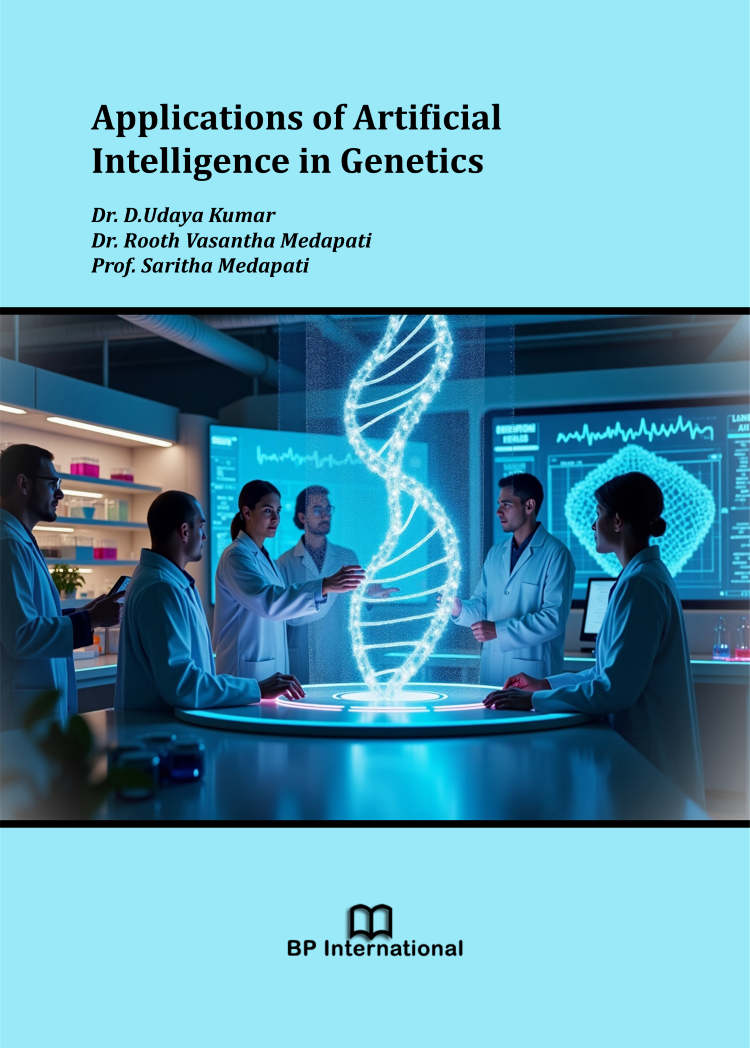
The remarkable convergence of Artificial Intelligence (AI) and genetics marks a transformative era in the life sciences. With the exponential growth of biological data and advances in computational power, AI has become an indispensable tool for decoding the complexity of the genome, driving new insights, and enabling precision in medical interventions. This book, Applications of Artificial Intelligence in Genetics, aims to explore the dynamic intersection of these two cutting-edge fields, providing a comprehensive understanding of how AI is reshaping genetic research and applications.
The journey begins with an Introduction to the fundamental concepts, setting the stage for readers with varied backgrounds. Chapter II offers an Overview of Artificial Intelligence in Biology, establishing the context and relevance of AI methods in the broader biological landscape.
From Chapter III onward, the focus narrows to the direct applications in genetics. AI in Genetic Data Analysis covers how machine learning and pattern recognition enhance the interpretation of complex datasets. Chapter IV delves into the use of Machine Learning for Genome-Wide Association Studies (GWAS), a pivotal area in identifying genetic variants linked to diseases.
AI in Gene Expression Profiling (Chapter V) and AI in Genomic Medicine (Chapter VI) highlight how AI facilitates understanding of gene activity and personalises therapeutic strategies. Chapter VII, Deep Learning Applications in Genetics, showcases the most advanced techniques in neural networks and their ability to model intricate genetic interactions.
No exploration of such a rapidly advancing field is complete without acknowledging its limitations. Chapter VIII addresses Challenges and Ethical Considerations, recognising the importance of responsible innovation. In Chapter IX, Future Directions, we speculate on the potential trajectories and upcoming breakthroughs. The book concludes with a summarisation in Chapter X and a comprehensive Bibliography in Chapter XI for further study.
This book is intended for researchers, students, and professionals across disciplines—genetics, computer science, bioinformatics, and biomedical engineering—who are eager to understand and contribute to the growing field of AI-driven genetics. We hope this work serves as both a guide and an inspiration for those working at the frontier of modern science and technology.
Services:
1. Professional review, editing and plagiarism checking.
2. Professional cover-page design and typesetting.
3. Specialized English editing and proofreading
4. Digital Object Identifier (DOI) allotment.
5. ISBN number (online and print version)
6. Online publication of the book and printing in the press.
7. Royalty: (80:20) profit sharing between author and publisher from the sale of books. Authors will get 80% of the profit and Publisher will get 20% of the profit.
8. Normally Books will be closed access to increase the possibility of sale and authors will retain the copyright of the book chapter/ books. Special requests of open access books can also be considered in case of complete book publication.