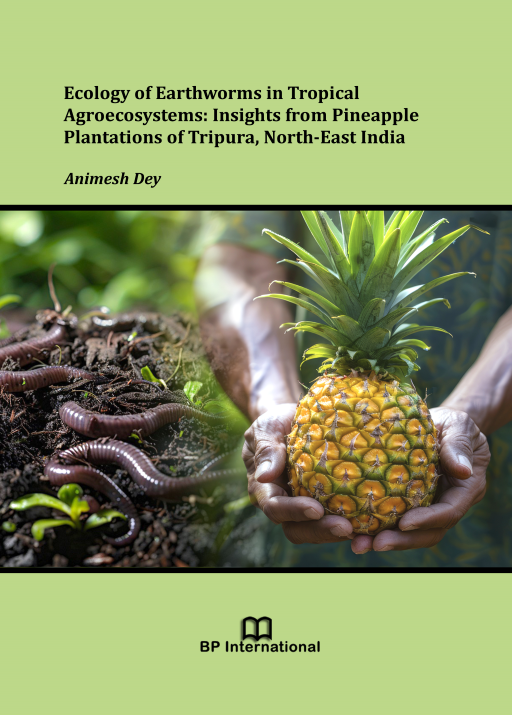
This book explores the intricate relationships between soil ecology, earthworm biodiversity, and sustainable agricultural practices, with a particular focus on pineapple (Ananas comosus) plantations in the state of Tripura, India. The chapters presented here are the outcome of years of systematic field research and scholarly inquiry aimed at uncovering the hidden dynamics of soil ecosystems in monoculture and mixed plantations.
Pineapple cultivation has deep historical roots, tracing its journey across continents to become an economically significant fruit crop in India. In Tripura, pineapple is cultivated with minimal external inputs, offering a unique opportunity to study natural soil-biota interactions in a subtropical agroecosystem. At the heart of these interactions are earthworms—often termed "ecosystem engineers"—whose roles in soil structure, nutrient cycling, and organic matter decomposition are pivotal for sustainable land management.
Despite a growing global interest in soil biodiversity, our understanding of earthworm communities in tropical monoculture systems remains fragmented. This book attempts to bridge that gap by presenting detailed findings on earthworm diversity, distribution patterns, ecological roles, and responses to varying plantation types, ages, and management practices. It also highlights the potential of vermicompost as a sustainable soil amendment to improve crop productivity and soil health.
Drawing on extensive field surveys, ecological experiments, and quantitative analyses—including species accumulation and richness estimation techniques—this work offers valuable insights for ecologists, agronomists, soil scientists, and policymakers engaged in biodiversity conservation and sustainable agriculture. It is my hope that the findings compiled here will not only enrich academic understanding but also inspire practical interventions to promote soil biodiversity and resilience in tropical agricultural landscapes.
Author(s)
Animesh Dey
Ecology & Biodiversity Laboratory, Department of Zoology, Tripura University (A Central University), Suryamaninagar – 799022, Tripura, India.
ISBN 978-81-991363-1-1 (Print)
ISBN 978-81-991363-6-6 (eBook)
DOI: https://doi.org/10.9734/bpi/mono/978-81-991363-1-1
This book explores the intricate relationships between soil ecology, earthworm biodiversity, and sustainable agricultural practices, with a particular focus on pineapple (Ananas comosus) plantations in the state of Tripura, India. The chapters presented here are the outcome of years of systematic field research and scholarly inquiry aimed at uncovering the hidden dynamics of soil ecosystems in monoculture and mixed plantations.
Pineapple cultivation has deep historical roots, tracing its journey across continents to become an economically significant fruit crop in India. In Tripura, pineapple is cultivated with minimal external inputs, offering a unique opportunity to study natural soil-biota interactions in a subtropical agroecosystem. At the heart of these interactions are earthworms—often termed "ecosystem engineers"—whose roles in soil structure, nutrient cycling, and organic matter decomposition are pivotal for sustainable land management.
Despite a growing global interest in soil biodiversity, our understanding of earthworm communities in tropical monoculture systems remains fragmented. This book attempts to bridge that gap by presenting detailed findings on earthworm diversity, distribution patterns, ecological roles, and responses to varying plantation types, ages, and management practices. It also highlights the potential of vermicompost as a sustainable soil amendment to improve crop productivity and soil health.
Drawing on extensive field surveys, ecological experiments, and quantitative analyses—including species accumulation and richness estimation techniques—this work offers valuable insights for ecologists, agronomists, soil scientists, and policymakers engaged in biodiversity conservation and sustainable agriculture. It is my hope that the findings compiled here will not only enrich academic understanding but also inspire practical interventions to promote soil biodiversity and resilience in tropical agricultural landscapes.